CARVES
Context And Reuse – the Valued Experience of Sustainability

BELSPO
Latest updates about the CARVES project

CARVES: Sampling of the Ivory Panels for DNA and Isotope Analysis
Update August 2026


Coordinators: Louise Decq (KIK-IRPA, Polychrome Artefacts Lab) and Emmanuelle Mercier (KIK-IRPA, Polychrome Wood Sculpture Studio)
Partners: Sophie Balace and Emile Van Binnebeke (RMFAB), Gontran Sonet and Quentin Goffette (RBINS), and Riccardo Pizzinato (University of Texas Rio Grande Valley)
BELSPO Programme Manager: Helena Calvo del Castillo
Description: The CARVES project focuses on the Genoels-Elderen diptych, an exceptional ivory object preserved at the Royal Museums of Fine Arts of Belgium (RMFAB). Engraved traces on the reverse reveal the presence of earlier Roman motifs and bear witness to a history of reuse and transformation. Used successively as tabulae, a book cover, and an element of altar decoration, this object tells several centuries of history in its own right. By combining scientific analyses with archival research, the project traces its journey—from tusk to museum. The project also promotes exchanges with the scientific community and dialogue with the public.
Keywords: reuse; material history; scientific analyses; public engagement.
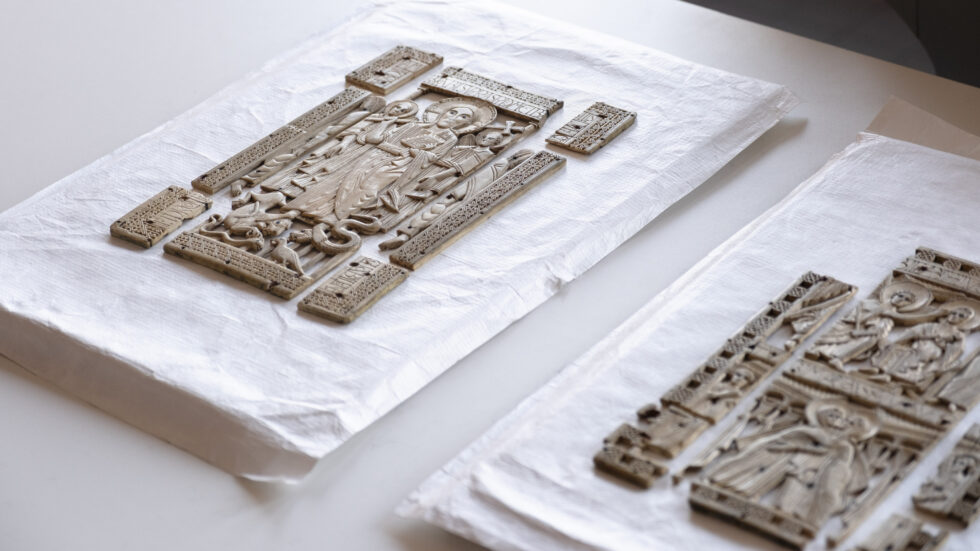
The CARVES project (Context And Reuse – the Valued Experience of Sustainability) explores the extraordinary history of a single ivory object that has undergone multiple transformations over more than fifteen centuries: the so‑called Genoels‑Elderen Ivories (Art & History Museum, Brussels, Inv. 1474).
Today, the two ivory plaques display eighth-century Christian images depicting Christ Trampling the Beasts, the Annunciation, and the Visitation. They rank among the earliest medieval European ivories preserved in Belgian museum collections. Yet these carvings represent only one chapter in a much longer story.
In 2022, the ivories were removed from their display case at the Art & History Museum for close examination. For the first time, previously unnoticed silhouettes of figures and traces of inscriptions were observed on their reverse sides. These discoveries revealed that the plaques are true ivory palimpsests, preserving evidence of repeated reuse, transformation, and adaptation through the centuries.
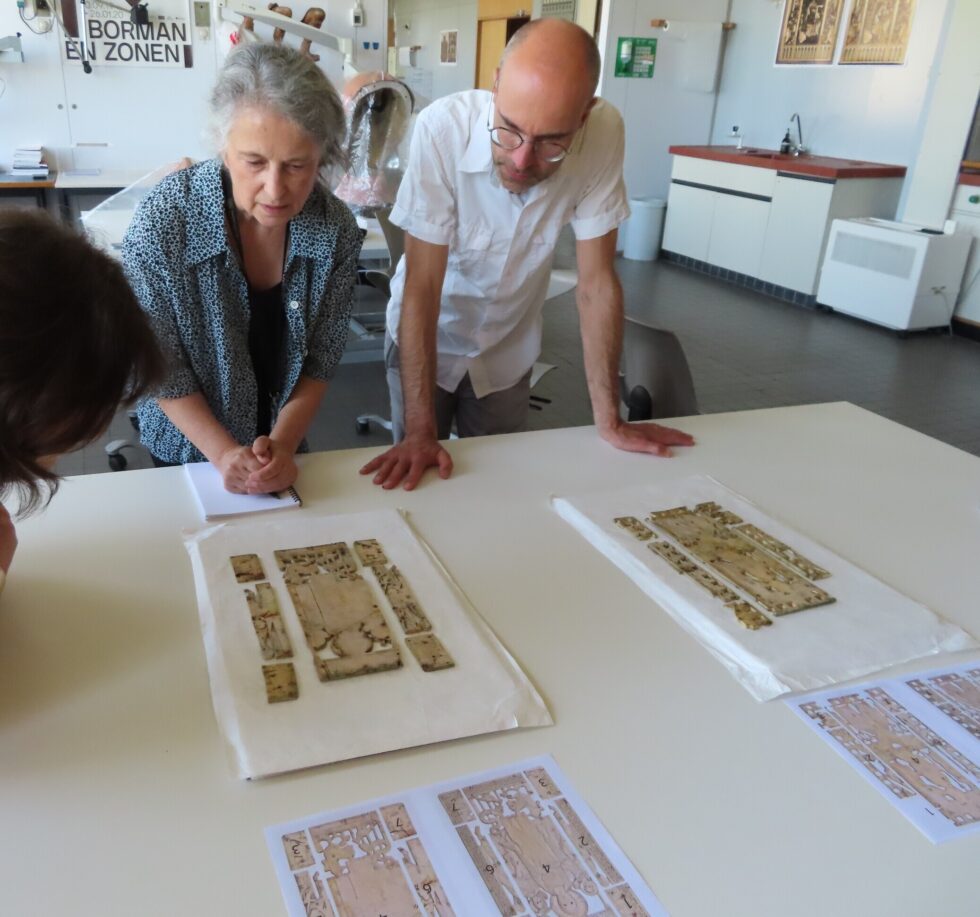
Originally carved from one or more elephant tusks, the Genoels‑Elderen ivories began their existence as a pair of Roman consular diptychs. These prestigious ivory tablets were commissioned by newly appointed consuls to celebrate their accession to office. Their original decoration depicted consular imagery carved in relief, while the opposite sides were left smooth and could be used for writing.
Several centuries later, when ivory had become scarce and highly valued, the original Roman imagery was deliberately erased. In the eighth century, new Christian scenes were carved onto the plaques, giving the ancient objects new meaning and function. Recently identified inscriptions further reveal that the ivories were later reused as the covers of a manuscript, most likely a Gospel book. One inscription indicates that this book was restored in Maastricht during the fifteenth century.
Later, the plaques were removed from the manuscript and appear to have been incorporated into the decoration of an altar step in the church of Saint Martin at Genoelselderen, in present-day Limburg. After their rediscovery, the ivories passed through several hands before the Art & History Museum in Brussels acquired them in 1865.
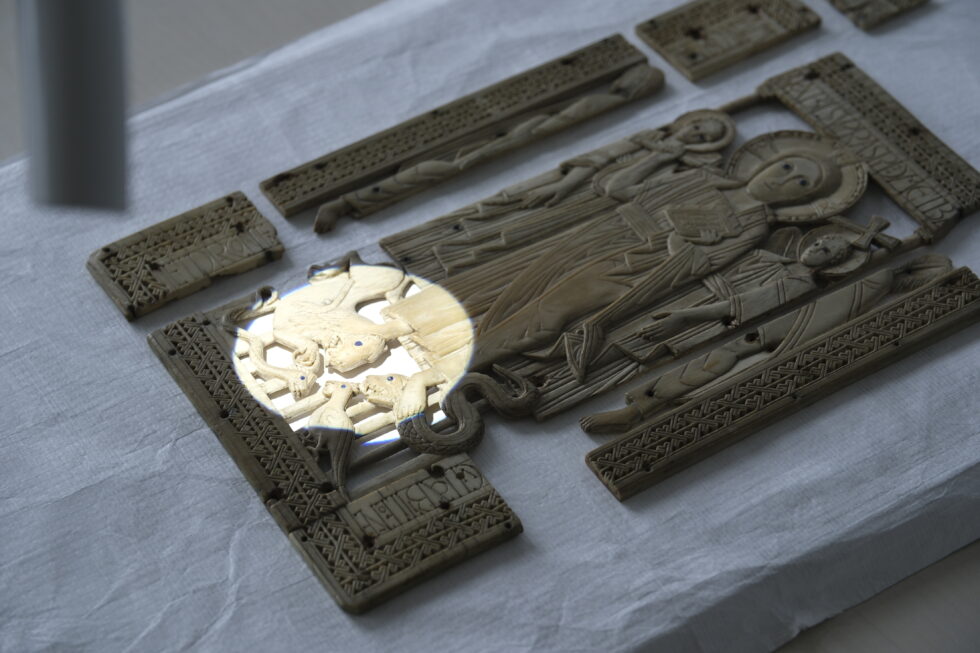
For the last 150 years, they have lived yet another life as museum objects, helping to tell the story of the artistic, religious, and cultural history of our regions. From elephant tusk to Roman consular diptych, from manuscript binding to church furnishing, and finally to museum treasure, the Genoels‑Elderen ivories embody a remarkable history of reuse and sustainability.
The CARVES project seeks to reconstruct this long and complex biography: an ivory object with at least five distinct lives, each leaving traces that can still be read today.
Project partners


MOSAIC
Material Outcomes of Sorption Analysis in Interdisciplinary Conservation.
